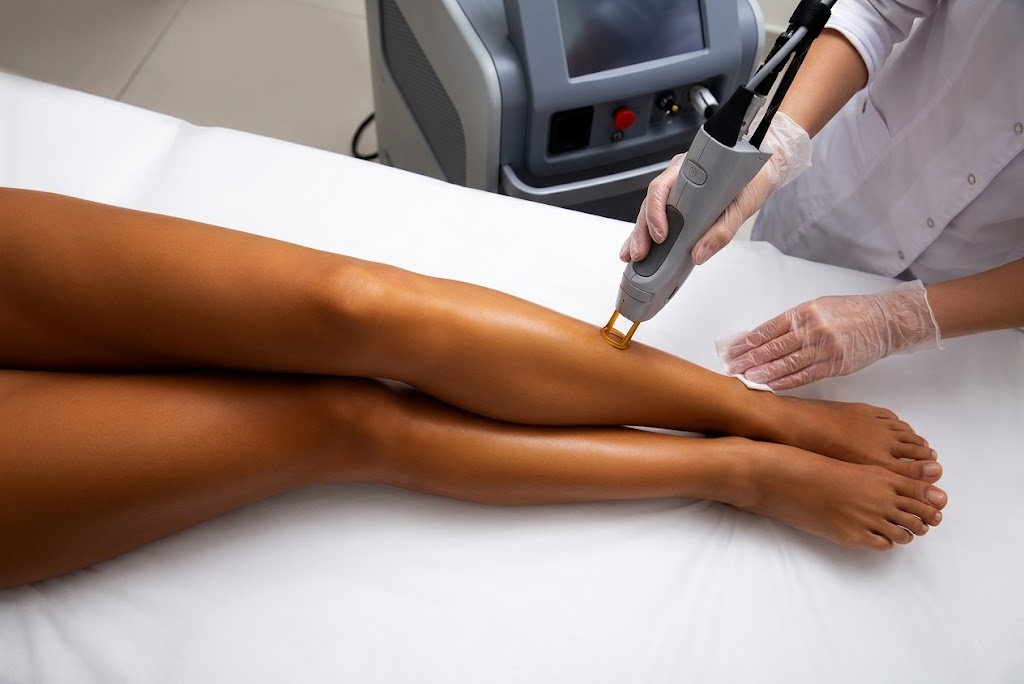
Yes, when the right laser is used. The risk people hear about with laser hair removal on darker skin isn't really about skin tone. It's about equipment. Older, single-wavelength lasers were built and tested on lighter skin, and using them on deeper skin tones is where burns and dark marks come from. That's a real, documented problem, and it's also a solved one, as long as the equipment and the technician account for it.
Here's what's actually going on, and what to check before you book.
Why Skin Tone Changes the Equation
Laser hair removal works by targeting pigment in the hair. The problem on darker skin is that there's also a lot of pigment in the skin itself, and older lasers can't always tell the difference.
755nm Alexandrite lasers are absorbed strongly by pigment. On light skin, that's exactly what you want: the light goes straight to the hair with little competition. On deeper skin tones, the skin's own pigment absorbs a lot of that energy too, which is what causes burns and dark or light patches when this wavelength is used without the right precautions.
1064nm Nd:YAG lasers work differently. They're absorbed less by pigment overall, but they penetrate deeper, which lets them bypass a lot of the pigment sitting in the skin's surface layer and reach the hair follicle underneath instead. This wavelength has been recognized as the safer option for deeper skin tones for decades. It's the reason Nd:YAG became the standard choice for treating Fitzpatrick IV-VI skin.
Most modern clinics, including ours, use dual-wavelength systems that switch between these based on the client's skin tone, rather than forcing everyone through the same setting.
The Fitzpatrick Scale, Briefly
Providers classify skin tone using the Fitzpatrick scale, a six-point system based on how skin responds to sun exposure, not just how it looks:
| Type | General Description | Typical Laser Approach |
|---|---|---|
| I-II | Pale, burns easily, rarely tans | Alexandrite works well |
| III | Medium, tans gradually | Either wavelength, case by case |
| IV | Olive to light brown, tans easily | Nd:YAG generally preferred |
| V-VI | Brown to deep brown/black | Nd:YAG standard |
This matters because a tan temporarily shifts where someone falls on this scale, which is the next issue.
Why a Fresh Tan Is Its Own Risk, Regardless of Your Baseline Skin Tone
This is the part that catches people off guard. Even if you're naturally fair-skinned, a recent tan (sun or self-tanner) puts extra pigment in your skin's surface layer temporarily, and a laser calibrated for your usual skin tone can overheat that area.
Sun tan: New pigment production stays active for weeks after the exposure that caused it, not just while the tan is visibly there. Most providers ask clients to wait 4 to 6 weeks after meaningful sun exposure before treating the area.
Self-tanner: The pigment in self-tanning products sits on the surface of the skin and absorbs laser energy the same way real pigment does, which can cause surface burns unrelated to your actual skin tone underneath. Self-tanner needs to be fully grown out and exfoliated off, not just faded, before a session, generally around 2 weeks with proper exfoliation.
Skipping either of these isn't a minor rule. It's the single most common reason someone with otherwise safe skin for laser ends up with a burn.
What Actually Causes the Bad Outcomes You Hear About
Three things, almost always in combination:
1. Wrong wavelength for the skin tone. Using an Alexandrite-only or single-wavelength device on Fitzpatrick IV-VI skin without adjusting for it.
2. No skin history check. Not asking about recent sun exposure or self-tanner use before treating.
3. Inexperienced settings. Fluence (energy level) that's too high for the skin's actual pigment level at the time of treatment, tan included.
None of these are inherent to darker skin. They're all things a competent provider using the right equipment controls for. Modern dual-wavelength systems with active cooling exist specifically to remove this risk, not just reduce it.
What Good Practice Looks Like
If you have deeper skin or a recent tan, a few things separate a safe appointment from a risky one:
- The provider asks about recent sun exposure, tanning, and self-tanner use before treating, not after something goes wrong.
- The equipment offers a true 1064nm Nd:YAG option, not just a single Alexandrite or diode setting applied to everyone.
- Settings get adjusted per person, not run at one fixed level regardless of skin tone.
At Callista, we treat all Fitzpatrick skin types on the Candela GentleMax Pro, which pairs 755nm Alexandrite and 1064nm Nd:YAG in the same device, so the wavelength gets matched to your actual skin rather than whatever the machine happens to default to.
Does It Still Work as Well on Dark Skin?
Yes. Clinical results on Fitzpatrick IV-VI skin using Nd:YAG show hair-density reduction in the same general range as lighter skin types, roughly 80-90% over a full course, with a properly matched wavelength and settings. Dark or coarse hair, which is common alongside deeper skin tones, actually responds well to laser overall, since more pigment in the hair itself gives the laser more to target. The skin tone isn't the limiting factor. The equipment and the protocol are.
What Callista Offers
We run laser hair removal on the Candela GentleMax Pro for every skin tone we treat, switching between Alexandrite and Nd:YAG based on your Fitzpatrick type and any recent sun or self-tanner exposure. Session and pricing detail is in our laser hair removal guide and pricing breakdown. If you've been told before that your skin tone made you a poor candidate, it's worth a consultation to find out whether that was actually about your skin or about the equipment being used on you.
Julia is a co-founder of Callista Beauty & Spa in Jefferson Park, Chicago, a beauty professional originally from Ukraine with 15 years in cosmetology. Her background shapes how the team approaches skin and body treatments across the salon.
Frequently Asked Questions
Is laser hair removal safe for Black or brown skin?
Yes, when the provider uses a 1064nm Nd:YAG laser or a dual-wavelength system matched to your skin tone. The risk comes from using equipment built for lighter skin without adjusting for darker tones, not from darker skin itself.
Can I get laser hair removal if I have a tan?
Not right away. A fresh tan, from the sun or self-tanner, temporarily increases surface pigment and raises burn risk regardless of your natural skin tone. Wait about 4 to 6 weeks after sun exposure, or about 2 weeks after self-tanner with full exfoliation, before treating the area.
What laser is best for dark skin?
1064nm Nd:YAG. It's absorbed less by surface pigment and penetrates deeper, reaching the hair follicle while mostly bypassing the pigment sitting in the skin above it. It's been the standard recommendation for Fitzpatrick IV-VI skin for years.
Why did I get burned or discolored from laser hair removal before?
Most commonly because the wrong wavelength was used for your skin tone, your skin history (like a recent tan) wasn't checked, or the energy setting was too high for your skin's actual pigment level at the time. These are equipment and protocol issues, not signs that laser can't work for you.
Does laser hair removal work as well on dark skin as light skin?
Yes, with the right wavelength. Clinical results on Fitzpatrick IV-VI skin using Nd:YAG show hair reduction in the same general range as lighter skin, and dark, coarse hair generally responds well to laser since it has more pigment for the laser to target. ---
Ready to experience it yourself?
Book an appointment at our Jefferson Park location in Chicago.
Book Now